



Why Clinical Trials Fail at the Execution Level
And how disciplined oversight prevents timeline and data risk
Most clinical trials do not fail at the level sponsors expect. They fail quietly, during execution, long before endpoints are reached. Not because the science is flawed, but because operational alignment deteriorates across sponsors, CROs, sites and vendors.
This deterioration is rarely visible in real time. By the time it surfaces, it is already embedded in timelines, data quality and study integrity.
These failures are rarely sudden. They emerge gradually through:
- unclear ownership of risk
- fragmented operational coordination
- delayed identification of issues
- inconsistent application of risk-based approaches
By the time symptoms appear (missed timelines, inconsistent data, protocol deviations), the underlying causes are already embedded in the system.
This paper outlines:
- where execution failures originate
- how they propagate across a study
- and how a governance-led model grounded in Quality by Design (QbD) and Risk-Based Quality Management (RBQM) mitigates these risks early
Execution Drift: The Hidden Failure Mechanism
One of the most difficult aspects of execution drift is that studies may continue appearing operationally stable while underlying alignment is already deteriorating.
Status reports may remain acceptable. Metrics may remain within expected ranges. Governance meetings may continue occurring on schedule.
However, beneath these indicators, decision latency, fragmented accountability and operational inconsistency may already be compounding across the program.
This creates a false sense of control that often delays intervention until risks become materially visible.
Execution drift occurs when:
- operational decisions become inconsistent across stakeholders
- risk signals are identified but not acted upon in time
- accountability becomes diffused across multiple functional layers
It does not present as a single failure. It manifests as small, compounding misalignments that gradually degrade study control. In early-phase studies, where assumptions are still being tested, this drift accelerates rapidly.
Early-Phase Studies: Conditions of Elevated Operational Instability
Early-phase studies operate under conditions of elevated uncertainty.
Unlike later-stage programs, where operational assumptions are more stable, early-phase studies frequently involve:
- evolving eligibility interpretation
- emerging safety observations
- protocol adaptation
- uncertain enrollment behavior
- dynamic vendor coordination requirements
- rapidly changing operational priorities
Under these conditions, even small gaps in alignment can propagate quickly across the study ecosystem.
As a result, execution discipline becomes increasingly important during the earliest stages of development, where operational instability is highest and corrective timelines are shortest.
Where Execution Failures Begin
Misaligned Governance Structures
In many trials, governance is assumed rather than explicitly defined.
Typical gaps:
- unclear escalation pathways
- overlapping responsibilities between sponsor and CRO
- absence of real-time decision authority
Impact:
Delays in decision-making, inconsistent responses to issues and reactive management.
Over-Reliance on Reactive Monitoring
While RBQM is widely adopted in principle, its execution often remains reactive.
In many studies, RBQM is implemented as a toolset, not as a decision framework.
Signals may be detected centrally, but without predefined ownership and escalation authority, they do not translate into timely operational action.
Common issues:
- delayed signal detection
- insufficient central monitoring integration
- lack of predefined thresholds for action
Impact:
Problems are identified after they have already affected timelines or data quality.
Feasibility Assumptions vs Operational Reality
Initial feasibility often relies on:
- optimistic enrollment projections
- incomplete site capability assessments
- limited consideration of competing studies
Impact:
Enrollment delays, protocol deviations and increased site burden.
Fragmented Vendor Ecosystems
Modern trials involve multiple specialized vendors:
- data management
- imaging
- safety
- laboratory services
Without structured coordination:
- data flows become inconsistent
- communication gaps increase
- accountability becomes diluted
Impact:
Operational drift across functions.
How Execution Drift Manifest in Early-Phase Programs
Execution issues rarely remain isolated.
They propagate through:
- timeline slippage
- data inconsistencies
- increased protocol deviations
- regulatory risk exposure
These effects compound over time, often becoming visible only at critical milestones.
As operational fragmentation increases, studies may also become increasingly difficult to defend from an inspection-readiness perspective.
Inconsistent escalation pathways, delayed decision-making and fragmented oversight structures can create gaps in documentation traceability and governance rationale, particularly when multiple vendors and decentralized operational functions are involved.
Operational Patterns Frequently Observed in Early-Phase Studies
In early-phase studies, execution challenges rarely originate from a single failure point. They typically emerge from misalignment between protocol intent and operational reality.
In one representative early-phase program, initial feasibility assumptions were based on:
- projected enrollment rates from historical datasets
- limited validation of site-level operational readiness
- underestimation of competing studies within the same indication
As the study progressed:
- enrollment performance began diverging rapidly between sites, creating pressure to continuously revise operational assumptions
- protocol deviations began to cluster around specific procedures
- operational timelines became increasingly reactive, requiring repeated modifications to preserve study continuity
Importantly, these signals were present early, but were not integrated into a unified decision framework. The issue was not lack of data. It was lack of structured governance to interpret and act on that data in real time.
This pattern is frequently observed in early-phase programs, where assumptions are still being tested and operational conditions evolve rapidly.
Governance-Led Execution Model (Operationalized)
Effective execution requires more than oversight. It requires a defined governance system that drives decision-making in real time.
This includes:
- Explicit Ownership of Risk: Each critical risk is assigned to a functional owner with decision authority.
- Predefined Escalation Triggers: Thresholds are established at study start to define when action is required.
- Integrated Signal Review: Data from monitoring, safety, and operations are reviewed collectively, not in isolation.
- Continuous Sponsor–CRO Alignment: Governance forums ensure that decisions remain aligned with study objectives as conditions evolve.
This structure transforms RBQM from a detection model into an execution model.
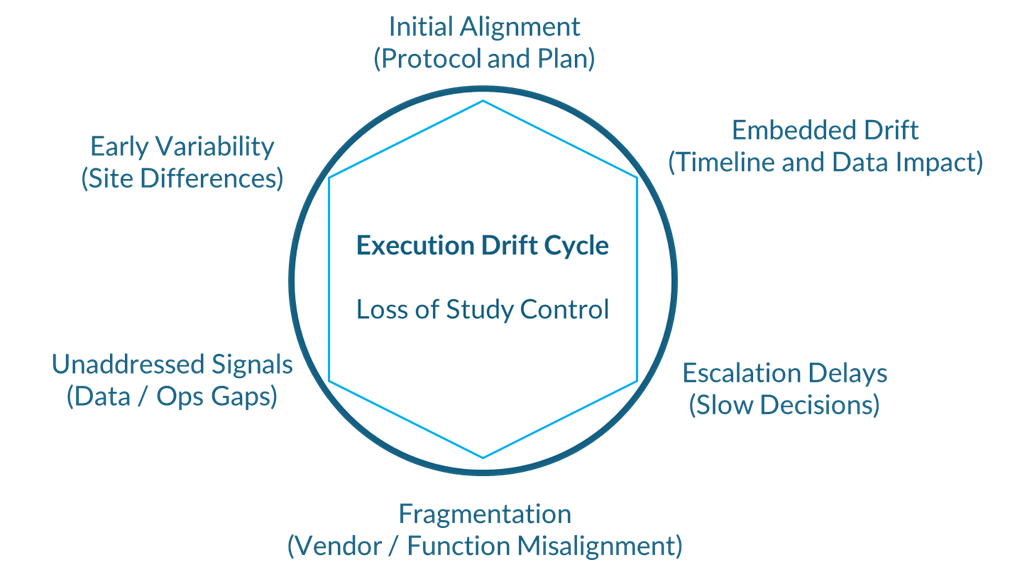
Execution Drift Lifecycle Diagram
This visual shows that failure is not a single event, but a progressive degradation of control:
- Initial alignment (everything looks fine)
- Early variability (normal, but unmanaged)
- Signals emerge (but are not acted on)
- Fragmentation increases
- Decisions slow down
- Drift becomes embedded in timelines and data
Control becomes difficult to recover from. Without structured governance, these transitions often go unnoticed until critical milestones are impacted.
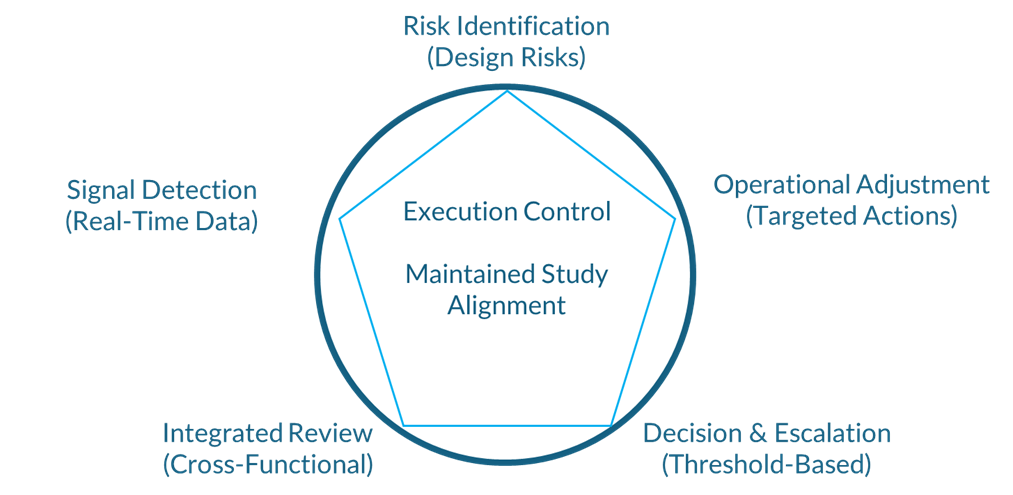
Governance Control Loop Diagram
Effective execution requires more than periodic oversight. It requires a continuous control system where risks are identified, signals are detected in real time, and decisions are made within a structured governance framework. This loop ensures that emerging issues are not only identified, but interpreted, escalated, and addressed before they impact timelines or data integrity. In this model, Risk-Based Quality Management becomes an active execution tool, rather than a passive monitoring function.
What Sponsors Often Underestimate
Many execution risks are not introduced after study start-up.
They are introduced much earlier:
- during feasibility assumptions
- governance design
- vendor integration planning
- and operational role definition
By the time issues become visible operationally, the structural conditions that enabled them are often already embedded within the study model itself.
How Sponsors Should Evaluate CRO Execution Models
When selecting a CRO, sponsors should assess not only capabilities, but execution architecture:
- Is governance explicitly defined or assumed?
- Who owns risk at the operational level?
- How quickly can signals translate into decisions?
- How are vendors integrated into the decision framework?
The difference between studies that remain controlled and those that drift
often lies in how these questions are answered before execution begins.
Conclusion
Clinical trial success is not determined solely by design.
It is determined by how effectively that design is executed.
A disciplined, governance-led approach ensures that risks are:
- identified early
- managed proactively
- and contained before impacting outcomes
Moving from Reactive Oversight to Proactive Execution
As clinical programs become increasingly complex, sponsors are reassessing how governance, operational oversight and risk management are structured across their studies.
Establishing alignment early, before execution drift occurs, can significantly improve visibility, responsiveness and overall study performance.
Evaluating How Your Trial Will Be Operationalized?
Many execution risks are introduced before the study begins, at the level of governance design, feasibility assumptions and operational structure.
Addressing these early can significantly reduce downstream timeline delays, protocol deviations and data variability.
Whether preparing for:
- First-in-Human studies
- Phase II expansion
- Multi-country execution
- or restructuring an active program
a structured discussion around execution strategy can surface risks that are otherwise difficult to detect once the study is underway.
Discuss your upcoming clinical program with our team: https://vantagebiotrials.com/contact/
About Vantage BioTrials
Vantage BioTrials is a clinical trial management CRO specializing in complex early- and mid-phase programs where operational variability and execution risk is highest.
Our approach integrates governance-led execution, Quality by Design (Qbd) and Risk-Based Quality Management (RBQM) into a unified operational framework designed to maintain alignment, responsiveness and inspection readiness across sponsors, sites and vendors.